
Agency & White-Label Services
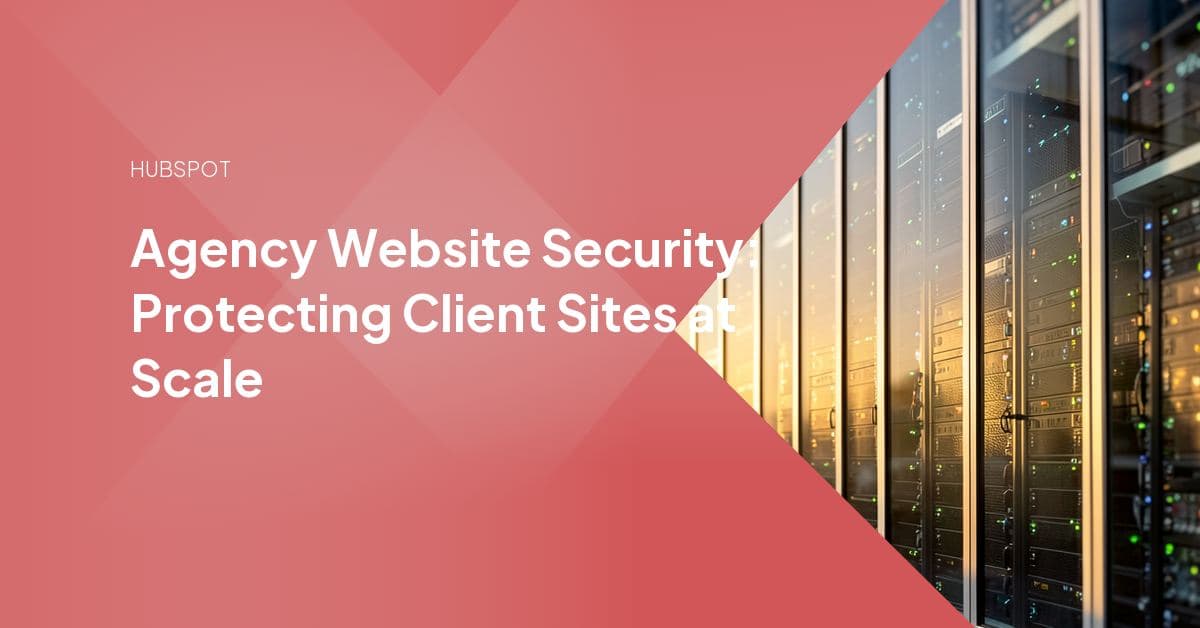
Agency Website Security: Protecting Client Sites at Scale
How agencies deliver and maintain secure client sites at scale: platform choice, security retainers, and white-label help from a Diamond HubSpot partner.
Key Takeaways
- Agencies contractually own the security of any client site they build, host, or manage, since a breach reflects on their own brand, not the client's.
- Building on a managed platform like HubSpot Content Hub shifts SSL/TLS, CDN, web application firewall, and DDoS protection off the agency's plate compared to self-hosted WordPress.
- Even on managed hosting, agencies still own access governance, offboarding discipline, 2FA enforcement, DNS/SSL configuration, form spam tuning, and custom code review.
- Security work should be billed as a recurring retainer line covering monitoring, access reviews, and quarterly audits, rather than a one-time launch task.
- Reserved capacity with a white-label delivery partner, such as Meticulosity, a Diamond HubSpot Solutions Partner with 17+ years and 11,800+ projects delivered, lets agencies scale security coverage without hiring risk.
When your agency builds or manages a client's website, you own its security. The uptime SLA, the after-hours incident call, and the reputation hit if data leaks all land on you, under your brand. That turns "website security" from a technical checklist into a delivery and packaging decision: which platform you build on, what you monitor every month, how you price it, and when you hand it to a partner.
This is the operator's view of website security for agencies: how to keep a book of client sites secure at scale without burying your team in patch cycles and midnight monitoring.
Who owns website security when an agency delivers the site?
The agency does. The moment you host, build, or manage a client's site, their form data, their uptime, and their compliance posture become your contractual responsibility, not theirs. A breach on a site you delivered is a breach of your promise, and clients rarely distinguish between "our agency" and "our agency's subcontractor" when their customer data is exposed.
Two things make this heavier for agencies than for a single in-house team. First, blast radius: a shared plugin vulnerability or a compromised admin credential can cascade across every client site you run the same way. Second, trust is the product. You're not just protecting a website; you're protecting the reason a client outsourced to you instead of hiring in-house. That's why security belongs in your delivery model, not bolted on after launch.
Platform choice is your single biggest security lever
The fastest way to shrink security work across a whole client roster is to build on managed infrastructure instead of self-hosting each site. On self-hosted WordPress, you personally own patching, plugin CVEs, the web application firewall, DDoS mitigation, and backups for every client, multiplied by every client. On HubSpot Content Hub, HubSpot's platform handles standard SSL, a global CDN, a web application firewall, DDoS protection, and 24/7 hosting-level monitoring, so those layers stop being per-site labor your team has to staff.
| Security layer | Self-hosted (WordPress/etc.) | HubSpot Content Hub |
|---|---|---|
| SSL/TLS certificates | You provision and renew per site | Standard, managed automatically |
| Core + plugin patching | Your team, per site, on every release | No plugin sprawl; platform-maintained |
| Web application firewall / DDoS | You configure and pay for add-ons | Built into hosting |
| CDN + uptime monitoring | You assemble and watch | Managed globally, 24/7 |
| Backups / rollback | Your responsibility to schedule and test | Content and version history managed |
Consolidating clients onto one managed platform doesn't just reduce risk; it makes your delivery repeatable. HubSpot's Solutions Partner Program is the gateway to 299,000+ global HubSpot customers, with IDC estimating a $42 billion partner services opportunity by 2030 (up from $19.1 billion in 2026), per HubSpot's partner program page. Standardizing on that ecosystem is a defensible security decision as much as a commercial one.
The security work that stays yours on a managed platform
Even on managed hosting, a specific slice of security never leaves the agency, because it lives in how you operate, not in the server stack. Own these explicitly in your scope of work:
- Access governance across portals. Least-privilege user roles in every client account, super admin kept to a tiny named group, and a documented owner for each portal.
- Offboarding discipline. Revoke access the day a client contract ends or a team member leaves, on both sides. Stale credentials are the most common quiet breach.
- 2FA and strong authentication. Enforce multi-factor authentication on every account that touches a client site or CRM, with no exceptions for convenience.
- Domain, DNS, and SSL configuration. Managed SSL still needs correct domain connection and DNS hygiene, which is squarely your job during onboarding and migrations.
- Form and bot spam. Managed hosting won't stop junk submissions polluting a client's CRM; that's tuning you own.
- Custom code review. Any serverless functions, custom modules, or third-party integrations you ship are your attack surface to review and back up.
- Incident response and comms. A written plan for who calls the client, what you say, and how fast, before anything goes wrong.
Package security as a recurring service, not a one-off
Bill security as an ongoing care-plan line inside a retainer, not a one-time launch task. Monitoring, access reviews, quarterly audits, and patch verification are recurring work, and recurring work needs recurring revenue to stay staffed. Scoping it as a project afterthought is how agencies end up doing critical security maintenance for free until something breaks.
The capacity math favors a retainer. HubSpot's 2026 State of Marketing report found 25.7% of marketers say their workload increased significantly over the past year and 47.4% report a moderate increase, even as most companies plan no significant headcount growth in 2026. Clients don't have the internal hands to run their own security cadence, which is exactly the gap a managed care plan fills. Framing security as a productized retainer, part of our white-label HubSpot support and portal management, also makes you stickier at renewal time.
That stickiness matters in a tighter market. Gartner's 2025 CMO Spend Survey found agencies accounted for 20.7% of total marketing spend, while 39% of CMOs said they plan to cut back their agency budgets over the coming year. Owning a client's security posture is one of the hardest line items for them to claw back in-house, which is precisely why it belongs in your packaging.
When to bring in a white-label delivery partner
Outsource security operations when the monitoring, patching, and incident load exceeds the capacity you can profitably staff, or when a client needs coverage (24/7 response, compliance audits, HubSpot development) that you can't justify hiring for full-time. A white-label delivery partner runs that work under your brand, so the client only ever sees your agency.
Reserved capacity with a partner is the model that scales security without the hiring risk: you keep a standing allocation of expert hours for portal audits, access reviews, and incident response, and draw on it as your roster grows. The trade-offs are real, and worth reading up on before you commit; see our guide to the common pitfalls and solutions in white-labeling and real-world white-label success stories. The non-negotiables: a signed confidentiality agreement, clear ownership of client credentials, and a partner who stays invisible to the client.
That's the model we run at Meticulosity as the HubSpot agency for agencies, a Diamond HubSpot Solutions Partner with 17+ years behind us, 11,800+ projects delivered, and 70+ white-label agency partners. Security maintenance is unglamorous, recurring, and easy to under-resource, which is exactly why handing it to reserved capacity often protects margins better than staffing it in-house.
Communicating security to clients, before and during an incident
Set the security conversation in the SOW, not in the middle of a breach. Spell out what you monitor, how often you audit, where client data lives, and who is reachable if something goes wrong. Clients judge your security less by the tools you use and more by how calmly and clearly you handle the moment something looks off.
Have an incident script ready: who contacts the client, within what window, and with what facts. A breach handled with a fast, honest, plain-language update can actually deepen a client relationship, while silence destroys it. Security done well is a retention story as much as a technical one, which is why it fits into building long-term client relationships beyond project deliverables. Deliver it consistently and it stops being a cost center and becomes a reason clients stay.
Sources
Frequently Asked Questions
Who is responsible for a client website's security when an agency builds or manages it?
The agency is responsible for a client website's security once it builds, hosts, or manages the site under its own brand and SLA. Form data, uptime, and compliance posture become the agency's contractual obligation, and a breach reflects on the agency's reputation, not just the client's.
How does HubSpot Content Hub reduce website security work compared to self-hosted WordPress?
HubSpot Content Hub reduces website security work by managing SSL/TLS certificates, a global CDN, a web application firewall, DDoS protection, and backups at the platform level. On self-hosted WordPress, an agency must provision, patch, and monitor every one of those layers itself, per client site.
What website security tasks stay the agency's job even on managed hosting?
Access governance, offboarding discipline, two-factor authentication enforcement, DNS and SSL configuration, form spam tuning, custom code review, and incident response planning all stay the agency's job even on managed hosting. These tasks live in how the agency operates, not in the platform's server stack, so no hosting provider handles them automatically.
How should agencies price website security work for clients?
Agencies should price website security as a recurring retainer line covering monitoring, access reviews, quarterly audits, and patch verification, rather than a one-time launch task. Treating it as a project afterthought leaves agencies doing critical security maintenance for free once a client site goes live.
When should an agency bring in a white-label partner for website security?
An agency should bring in a white-label partner for website security once monitoring, patching, and incident load exceed what it can profitably staff in-house, or when a client needs 24/7 coverage the agency can't justify hiring for. A reserved-capacity partner runs that work under the agency's own brand, invisible to the client.
The HubSpot Agency for Agencies
Ready to Grow Your Agency to the Next Level?
White-label HubSpot, marketing, design, and development: 17+ years, Diamond Partner, 11,800+ projects delivered for agencies like yours.
Related Articles
How to Track When a HubSpot Lead Status Changed
Lifecycle stage gets date properties for free. Lead status gets nothing. Here is the workflow pattern that gives you stage duration reporting anyway.