
Inbound Marketing
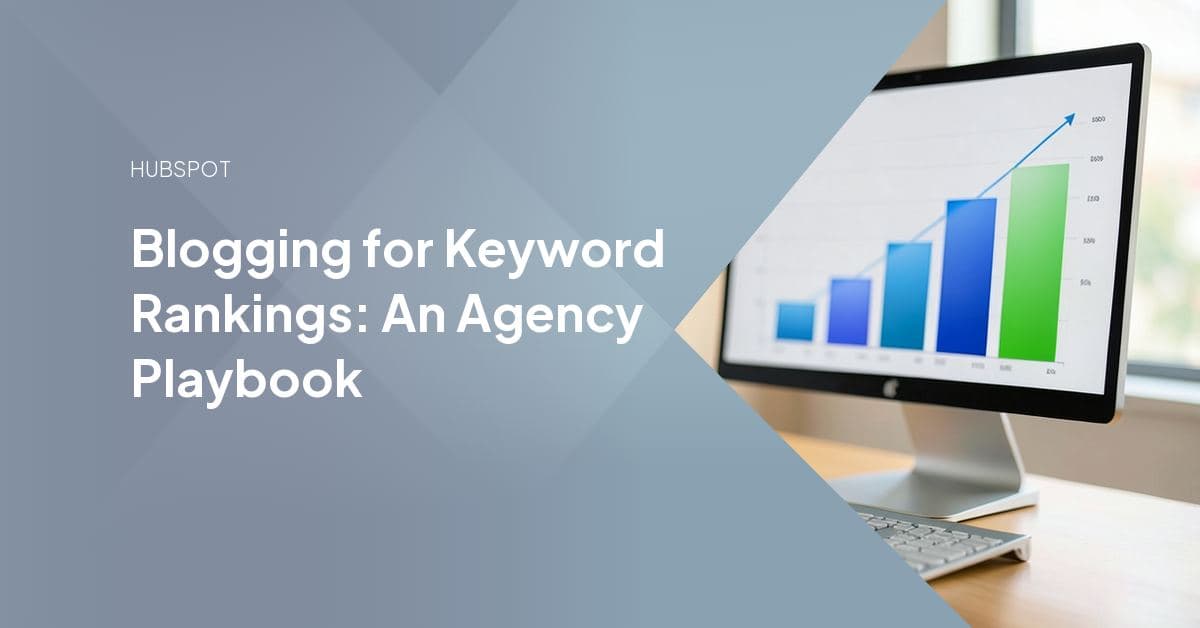
Blogging for Keyword Rankings: An Agency Playbook
How agencies deliver blog content that ranks and gets cited for clients, a full-funnel workflow from a Diamond HubSpot partner.

Key Takeaways
- Website, blog, and SEO efforts are the #1 ROI-driving marketing channel at 27%, ahead of paid social at 26%, per HubSpot's 2026 Marketing Statistics.
- Mapping a client's blog to the full buyer journey (problem, solution, provider stages) captures demand competitors ignore instead of only fighting for bottom-funnel terms.
- Package blogging as a fixed-cadence retainer (weekly vs. twice-weekly) tied to journey coverage, refresh load, and reporting overhead so account leads can defend the tier a client buys.
- 50% of marketers said their blogs generated higher ROI in 2024 than the year before, according to HubSpot's 2025 State of Blogging Report, a renewal argument for every quarterly review.
- Long-form posts generate more than 9x the leads of short ones, per Neil Patel, so retainers should scope for depth, not just word-count volume.
Blogging is still one of the most durable ways to move a client's keyword rankings, but the win is no longer a single term climbing to position one. It's a client's site becoming the source that ranks, converts, and gets cited across a whole cluster of buyer questions. For agencies, that reframes blogging from a commodity deliverable into a repeatable, packageable service. This is how we run it.
Does blogging still earn keyword rankings for clients?
Yes: organic content remains the single highest-ROI channel your clients have. Website, blog, and SEO efforts rank as the #1 ROI-driving marketing channel at 27%, edging out paid social at 26%, per HubSpot's 2026 Marketing Statistics. That's the number to put in front of a client debating whether to keep funding a content retainer versus shifting budget to ads.
The mechanism hasn't changed: publishing more relevant, well-structured content expands the range of terms a client ranks for, and broader rankings pull in more organic traffic that converts. What has changed is the surface. Rankings now feed AI Overviews and answer engines, so the goal of a blog program is to be the cited source, not just the tenth blue link. Package blogging as "own the client's topic," and the deliverable survives every algorithm shift.
Map client content to the full buyer journey
The highest-leverage move an agency makes is mapping a client's blog to every stage of their buyer's journey, not just the bottom-funnel terms they already chase. Most clients over-invest in "choose a provider" keywords and completely ignore the problem- and solution-awareness searches that happen first. That gap is your opening.
Take a client running an addiction-treatment clinic. Their instinct is to fight for "inpatient addiction clinic in [city]", the terms most likely to convert today. But the patient (and their family) runs a chain of searches long before that:
| Journey stage | What the client searches | Content the agency ships |
|---|---|---|
| Identifying the problem | "how can I tell if my child is using drugs?" | Symptom-explainer and diagnostic blog posts |
| Identifying a solution | "difference between inpatient and outpatient rehab" | Comparison guides, "is an intervention needed" pieces |
| Choosing a provider | "best inpatient addiction clinic in [city]" | Service pages, local landing pages, proof/case content |
This mapping is the delivery method, and it generalizes to any client vertical: SaaS, manufacturing, professional services. You build the keyword-to-stage map once, then produce against it on a schedule. Publishing into the problem and solution stages captures demand competitors ignore, widens the ranked keyword set, and feeds the bottom-funnel pages internal links and topical authority. Cadence is the lever that turns that map into coverage: a steady weekly publishing schedule works through the map systematically, and a twice-weekly schedule works through it faster, which is exactly the capacity conversation that justifies a larger retainer.
How to package and scale blog delivery
Package blogging as a fixed-cadence retainer tied to the client's journey map, not as one-off posts. Cadence is the lever: a once-weekly program builds steadily, while a twice-weekly program compounds faster, so tie the tier a client buys to the growth curve they want. Depth matters as much as frequency. Neil Patel has said long-form posts generate more than 9x the leads of short ones, so scope each piece for substance, not word-count padding, and give every post a headline built to earn the click.
Structure the engagement around capacity math your account leads can defend:
- Journey coverage: how many stages and topic clusters the retainer covers this quarter.
- Cadence: posts per week, mapped to the traffic trajectory the client is buying.
- Refresh load: updating existing posts, which is often the cheapest lead lift on the site and belongs in every retainer, not just net-new production.
- Reporting overhead: the standing ranking, traffic, and lead report that keeps the client renewing.
This is where white-label delivery earns its keep. An agency can hold the strategy and client relationship while a delivery partner produces the volume under the agency's brand, letting you sell a twice-weekly program without hiring writers ahead of revenue. Demand is durable: 50% of marketers said their blogs generated higher ROI in 2024 than the year before, according to HubSpot's 2025 State of Blogging Report, which is the renewal argument to put in every quarterly review. Our white-label content and blog delivery is built to plug into exactly this model.
Reporting: rankings, ROI, and LLM visibility
Report on ranked-keyword breadth and blog-sourced leads, not a single vanity term, and increasingly, on AI visibility too. A keyword climbing is easy to screenshot, but it's the wrong headline; what renews a retainer is showing the client that a widening set of posts brings in organic leads across many terms. Tie every post back to the client's conversion funnel so the report reads in revenue, not rankings, and lean on the numbers that actually move a marketing decision when you build the story.
The next reporting frontier is already here. As one agency leader put it on LinkedIn, clients are "getting asked to show LLM visibility the same way we used to show keyword rankings. Clean. Sortable. Definitive." Agencies that start folding "which prompts does the client show up on in ChatGPT and Perplexity" into their content reports now will own that conversation before it becomes table stakes. Structure your clients' posts to answer questions directly, and the same content that ranks becomes the content that gets cited.
Want a blog program that widens a client's ranked keyword set and gets cited by answer engines, delivered under your brand by a Diamond HubSpot partner? Talk to us.
Sources
Frequently Asked Questions
Does blogging still help clients rank in search?
Blogging still drives client keyword rankings, and it remains the single highest-ROI marketing channel: website, blog, and SEO efforts account for 27% of ROI, ahead of paid social at 26%, per HubSpot's 2026 Marketing Statistics. The win now is broader topic coverage and citation, not one term hitting position one.
How should an agency package blog content as a service?
Agencies should package blogging as a fixed-cadence retainer, weekly or twice-weekly publishing, tied to a client's buyer-journey map rather than selling one-off posts. Structuring the engagement around journey coverage, cadence, refresh load, and reporting overhead gives account leads a defensible basis for retainer tiers.
What keywords should a blog content plan target first?
A blog content plan should target problem-awareness and solution-awareness keywords first, not just bottom-funnel provider terms clients already chase. Most clients over-invest in "choose a provider" searches and ignore the earlier questions buyers ask, which is where an agency's content plan can win ranked keywords competitors skip.
How does AI search change blog reporting for agencies?
AI search means agencies now report on ranked-keyword breadth, blog-sourced leads, and emerging LLM visibility, not a single vanity keyword. Clients increasingly ask agencies to show which prompts they show up on in tools like ChatGPT and Perplexity, the same way they used to ask for keyword-ranking reports.
Does long-form blog content perform better than short posts?
Long-form blog content outperforms short posts for lead generation: Neil Patel has reported it generates more than 9x the leads of shorter articles. Agencies should scope retainer deliverables for depth and substance on each topic rather than padding word count to hit a target.
White-Label Digital Marketing
Full-Funnel Marketing Muscle, On Your Bench
End-to-end inbound and digital marketing, strategy to execution, delivered white-label or alongside your team.
Related Articles
Inbound Lead Generation Strategies for Agencies
How agencies deliver and scale inbound lead generation for clients: content, SEO, landing pages, and nurturing, white-label under your brand.